An on-vehicle subframe bushing tool is a good candidate only when it is designed for the actual bushing and subframe, the vehicle procedure permits the intended access, and the complete extraction and installation arrangement can be used. If those conditions are not met, an off-vehicle service route may be necessary. “On-vehicle” should never be read as “no preparation or disassembly.”
For workshop chains and tool distributors, the purchase should follow the service route. The relevant comparison includes access preparation, supporting equipment, tool setup, bushing positioning and completion checks. A low-priced cup set is not a complete solution if the customer still lacks the application-specific supports or installation components.
Describe the subframe and bushing precisely
Start with the vehicle model, production range and chassis generation, then identify the position being serviced. A subframe can contain more than one mounting or isolation component. A tool described for an engine support bush is not automatically suitable for every subframe-to-body mounting on the same vehicle.
Record the replacement-bushing reference, whether it is a one-piece or multi-part design, and whether the subframe is cast or pressed. Add photographs of the bushing from both accessible sides. Include surrounding structure so the tool supplier can assess how a receiver or support would locate.
Die Laser 9028 instructions illustrate this level of specificity: the tool addresses a particular split-bush application and identifies different support components for pressed-steel and cast-alloy arrangements. That example explains why a vehicle-brand label and bushing diameter are not enough to establish tool coverage.
Map the job before comparing the two service routes
Ask the workshop to describe the required stages using the vehicle service information. This is not a request to improvise a repair sequence. It is a way to identify which resources each approved route requires and where the proposed tool fits into the work.
| Stage | On-vehicle route: information needed | Off-vehicle route: information needed |
|---|---|---|
| Access preparation | Components to release or reposition and available operating clearance | Disconnection and removal scope for the subframe assembly |
| Support | Specified support for the vehicle and affected assemblies | Handling equipment and suitable bench or press fixtures |
| Extraktion | Dedicated driver, receiver, screw and any preparation accessories | Approved support and extraction arrangement |
| Installation | Orientation, depth and required insertion components | Equivalent positioning and support requirements off the vehicle |
| Completion | Reassembly and specified inspection or alignment work | Subframe refitting and all associated completion checks |
Fill the table from the actual procedure for each target vehicle. Do not assume that a workshop press eliminates preparation or that an on-vehicle tool eliminates reassembly checks. The comparison becomes useful when both routes are described to the same endpoint: a completed, checked repair.
Why on-vehicle work can still require substantial preparation
The tool needs room to enter, locate, operate and complete the required travel. Nearby structure may obstruct one of those stages even when the bushing face is visible. Ask for the assembled tool dimensions and the access requirements in its instructions, rather than judging from a photograph of the case contents.
A documented example is Laser’s 6051 front subframe bush tool. Its instructions describe application-specific preparation and lowering for access. Those steps belong to the listed vehicle arrangement; they should not be copied to unrelated vehicles. The purchasing lesson is that an on-vehicle description must be read together with its preparation requirements.
For workshop managers, identify who provides the vehicle data and who confirms that the proposed tool arrangement is suitable. This responsibility should be clear before purchasing a fleet-wide tool package. A catalogue description is not a replacement for a vehicle-specific procedure.
Evaluate the receiver and reaction surfaces
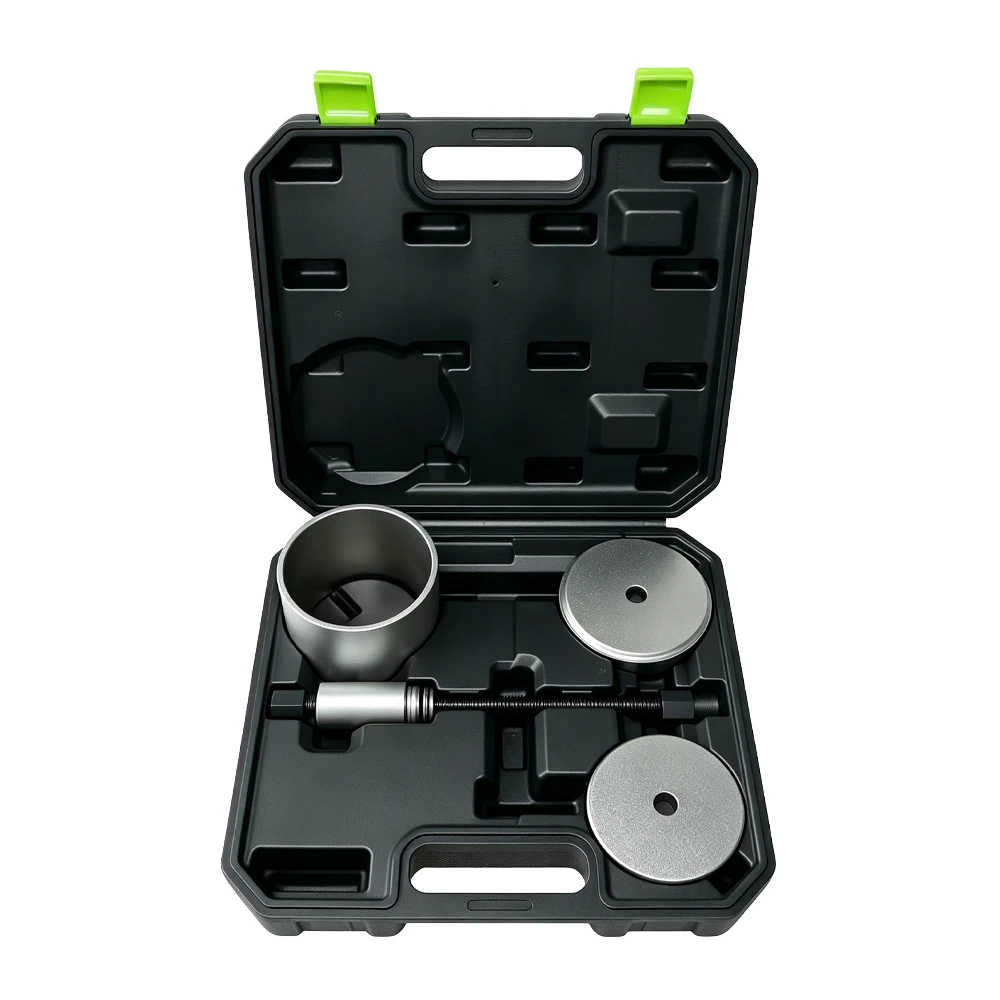
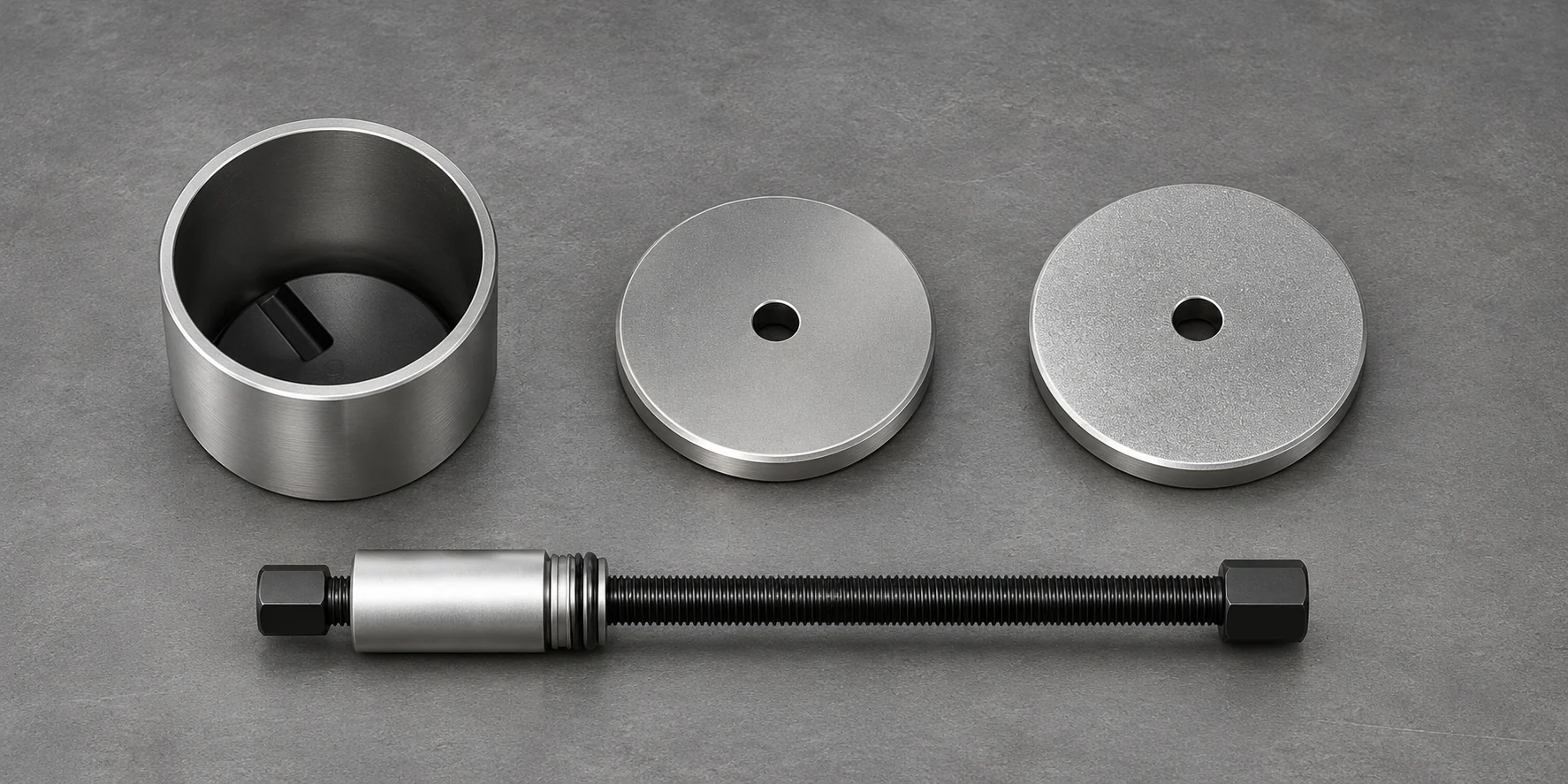
A subframe receiver must clear the component being removed while locating on the intended supporting area. Check its inside profile, usable depth and reaction rim. A cup with a sufficiently large bore may still contact the wrong part of a shaped subframe.
Ask for a drawing showing the receiver against the actual application. If a support is split, stepped or shaped, establish why that feature is required and which subframe version it serves. Do not replace it with a plain tube solely because the tube has a similar outside diameter.
For multi-part bushings, the removal and installation arrangements may use different components. Request separate illustrations and a complete parts list. A kit that extracts the old bush but lacks a required insertion sleeve is an incomplete purchasing scope for a replacement job.
The force system should also be identified as a whole. Record the screw, nuts, thrust components and any approved drive equipment. Ask for the operating limits and maintenance instructions for that configuration. A thread size or a general “heavy-duty” label does not establish compatibility.
Make orientation and installed position part of the order review
A bushing can have directional features, an asymmetric form or a specified installed position. The tool selection should preserve the ability to follow those requirements. Request the relevant positioning information for the actual bushing rather than assuming that every circular component is installed flush and at any rotation.
Check whether the kit includes a locating adapter, insertion sleeve or other part used to control the application. If the final position is established by a vehicle measurement rather than a tool stop, the instructions should make that distinction clear. The buyer needs to know what the kit supplies and what the workshop must determine from service data.
For a distributor, avoid claiming a finished result from the presence of an installation disc alone. A complete explanation should connect the disc to the intended application and the positioning method. This helps the customer distinguish a general cup assortment from a dedicated service system.
Compare total job cost using local workshop information
Do not assign a universal time saving to on-vehicle service. Labour depends on the vehicle, condition, available equipment and the procedure. Instead, ask a qualified workshop to record the stages of a representative evaluation and compare the complete routes.
For the on-vehicle option, include access preparation, tool setup, extraction, insertion, tool removal and reassembly. For the off-vehicle option, include disconnection, handling, press setup, refitting and the relevant completion checks. Record supporting equipment that is occupied during each route, since this can affect bay availability.
The tool purchase is one line in that comparison. Add separately required adapters, replacement force components and documentation or training needs. Use the workshop’s own labour rate and observed time if a cost calculation is needed. Supplier claims about convenience should not be converted into guaranteed savings.
For a chain, a dedicated kit may be easier to justify where the target vehicle family represents recurring demand. For a general distributor, a smaller selection of well-defined applications may be more supportable than an expansive catalogue with unclear exclusions. The commercial choice should follow the customer mix.
What belongs in a workshop-chain purchasing pack
Group the requirements by function rather than treating everything as part of one tool case. This makes omissions visible and helps compare quotations that include different items.
- Application information: vehicle generation, bushing position and replacement-part references.
- Core tooling: the complete extraction and installation system with identifiable components.
- Required supporting equipment: items specified by the vehicle and tool procedures but not included in the kit.
- Service parts and consumables: identified replacements and prescribed materials, with availability confirmed separately.
- Dokumentation: operating instructions, component drawings, application limits and inspection requirements.
- Commercial details: quantities by location, destination market and any packaging or language requirements for quotation.
Do not prescribe a single lubricant for every bushing or force screw. Tool and component instructions can specify different materials and conditions. The purchasing pack should ask for the applicable requirements, not replace missing information with a general statement to grease everything.
Check sample evidence at the application level
Keep a service-route record for each target vehicle group
For a chain introducing the tool across several locations, use one short record per application. Include the vehicle generation, bushing position, tool reference, required supporting equipment and the service-data reference used by the workshop. Add the intended removal and installation configurations and identify any parts supplied outside the main case.
This record helps distinguish a tooling problem from an incomplete rollout. If one branch has the dedicated receiver but another has only the base screw and cups, they do not have the same working capability. The purchase order and distribution list should make that difference visible before the first job is booked.
It also provides a controlled way to expand the range. When a new vehicle request arrives, compare its application information with the existing record. Do not extend coverage solely because the new subframe looks similar in a photograph. Request the relevant setup information and document any additional components or exclusions.
Where a tool is shared between locations, include a contents check on issue and return. Missing installation pieces can be overlooked when the extraction components are still present. A component-level inventory is more useful than recording only that the case was returned.
Reconcile the sample contents with the quotation and confirm that the instructions describe the delivered components. Review the dimensions of the working parts against the approved drawing. If a functional evaluation is performed, record the exact application and configuration, including any additional equipment.
A successful sample evaluation establishes information about that specific combination. It does not automatically cover another subframe material, bushing version or chassis generation. Keep these boundaries in the application list so that sales staff do not expand the claim during a later quotation.
Also agree how missing or worn components will be replaced. A dedicated tool with an unidentified support ring can become difficult to use after one part is lost. A parts diagram and stable references make a practical difference to long-term workshop support.
Use vehicle-specific listings as the start of the enquiry
Die VIKTEC Volkswagen subframe bushing removal and installation set is a relevant product to review for a defined application. Send the actual vehicle and bushing information when asking about it; the brand name in the title should not be read as coverage of every Volkswagen subframe.
For a mixed workshop range, compare it with other Werkzeuge zum Aus- und Einbau von Buchsen. Keep control arm, subframe and other bushing service requirements separate in the enquiry, even when some components look similar. This gives the supplier a clear basis for proposing the appropriate kits.
Questions before ordering a subframe bushing tool
Does on-vehicle capability mean the subframe bolts stay untouched?
No. The required preparation depends on the vehicle and tool application. Some procedures may involve releasing or repositioning components to gain access. Use the applicable service information and ask the supplier to identify the preparation assumed by its tool instructions.
Can one kit cover cast and pressed-steel subframes?
Only where its documented applications and supplied supports cover both. Different structures may require different reaction components. Ask for the relevant adapter references and exclusions rather than extending coverage from a shared vehicle platform.
Should an importer stock every vehicle-specific kit at once?
Not necessarily. Start with customer demand, vehicle populations in the target market and the applications that can be documented clearly. Separate confirmed opportunities from occasional requests, then decide which kits belong in regular stock and which should be quoted individually.
What information makes a quotation useful?
Provide the vehicle generation, bushing reference and position, subframe photographs, intended service route, quantities and destination market. Send a subframe bushing tool enquiry to VIKTEC and request the current contents, application information and commercial quotation for that scope.