Why Are Engine Misfires, Hard Starting, and Power Loss So Difficult to Diagnose?
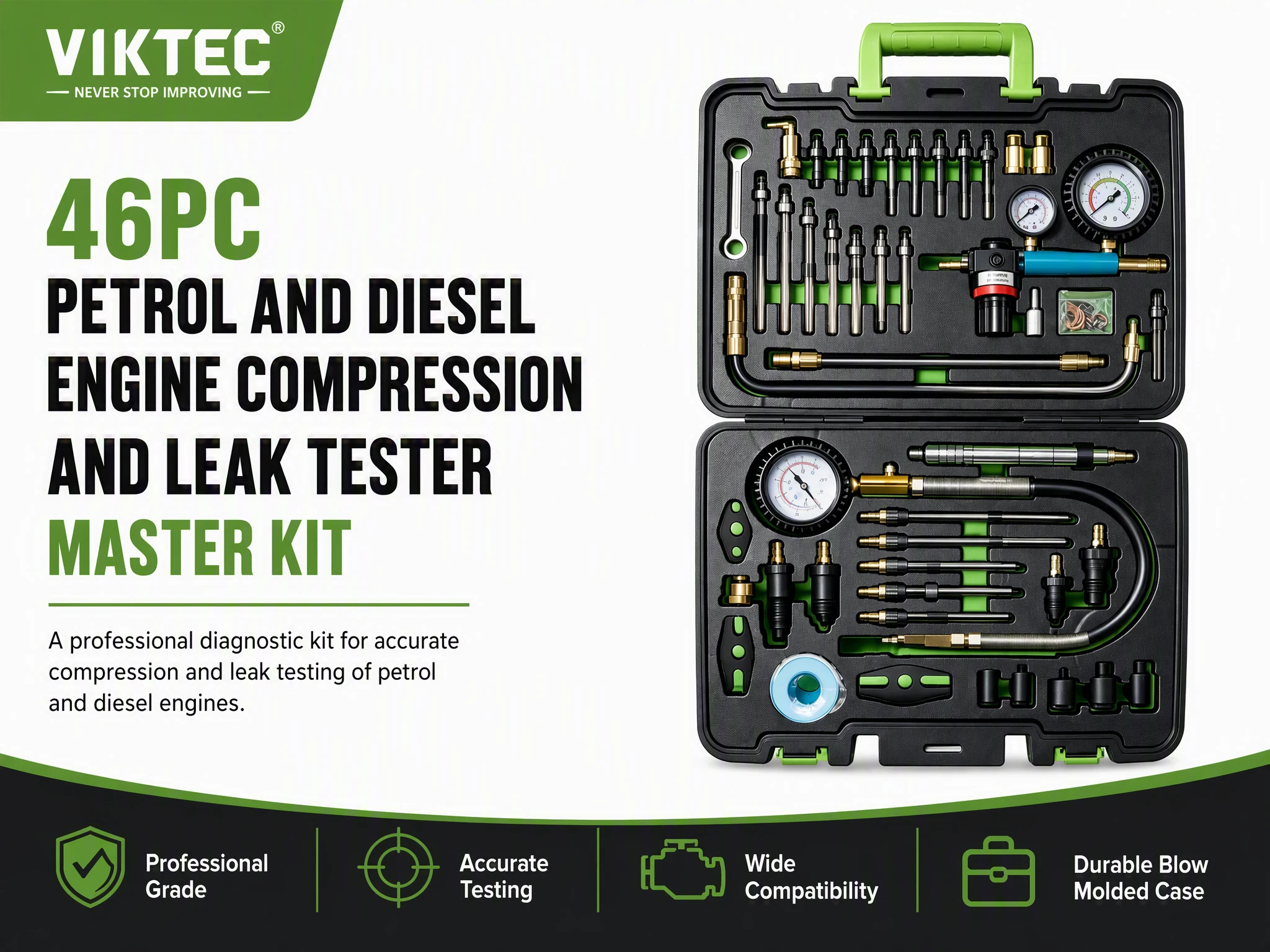
Engine misfires, low power, excessive oil consumption, difficult starting, and uneven idle can all point to poor cylinder sealing. The problem is that these symptoms may come from worn piston rings, leaking valves, a damaged head gasket, injector faults, or incorrect valve timing. Replacing parts before confirming the root cause wastes labor and increases repair costs. A combined compression test and cylinder leak-down test gives workshops a faster diagnostic path. Compression testing compares cylinder pressure, while leak-down testing shows where pressure is escaping. The 46PC Petrol and Diesel Engine Compression and Leak Tester Master Kit brings both methods together with twin gauges, quick-connect fittings, and a broad range of petrol and diesel adaptors.
A professional engine sealing diagnosis should compare cylinder compression, measure controlled leakage, and identify whether air escapes through the intake, exhaust, crankcase, or cooling system. VIKTEC supplies a 46-piece petrol and diesel master kit designed for workshops, distributors, and OEM or ODM tool programs.
The following sections explain the correct test sequence, the signs of a leaking head gasket, the main leak-detection methods, and the factors that influence measurement accuracy. This helps workshops select the right diagnostic process and helps professional buyers evaluate a suitable engine tester kit.
Compression Testing and Leak-Down Testing: What Is the Difference?
These tests are related, but they answer different questions. A compression test measures the pressure produced while the engine is cranked. A leak-down test introduces regulated compressed air into a cylinder at top dead center and measures how much pressure escapes. Using both tests provides a clearer picture than using either test alone.
| Diagnostic Method | What It Measures | Best Used For | Main Limitation |
|---|---|---|---|
| Compression Test | Cranking pressure produced by each cylinder | Finding weak cylinders and comparing cylinder balance | Does not directly show where pressure is escaping |
| Leak-Down Test | Percentage or relative amount of controlled air loss | Locating leakage through valves, piston rings, head gasket, or cylinder damage | Requires regulated shop air and accurate piston positioning |
How to Do a Leak Test on an Engine?
Begin by bringing the engine close to normal operating temperature, unless the vehicle Manufacturer specifies a cold test. Switch off the engine, disable the fuel and ignition systems, and remove the relevant spark plug, glow plug, or injector.
Rotate the crankshaft until the piston is at top dead center on the compression stroke. Both valves must be closed. Incorrect positioning can cause the crankshaft to rotate when air pressure is applied.
- Warm the engine: Bring the engine close to normal operating temperature.
- Disable fuel and ignition: Prevent the engine from starting during preparation.
- Remove the required component: Remove the spark plug, glow plug, or injector.
- Position the piston: Set the cylinder at top dead center on the compression stroke.
- Install the adaptor: Select an adaptor that seals correctly in the cylinder opening.
- Connect the tester: Attach the hose and twin-gauge leak-back tester.
- Apply regulated air: Supply clean and stable workshop air according to the tester instructions.
- Read the result: Record the leakage indication and compare all cylinders.
- Locate the leak: Listen at the intake, exhaust, crankcase, and cooling system.
Noise at the intake suggests an intake-valve leak. Noise at the exhaust suggests an exhaust-valve leak. Air escaping from the oil filler or crankcase breather may indicate piston-ring or cylinder wear. Bubbles in the cooling system may indicate a head-gasket or cylinder-head problem.
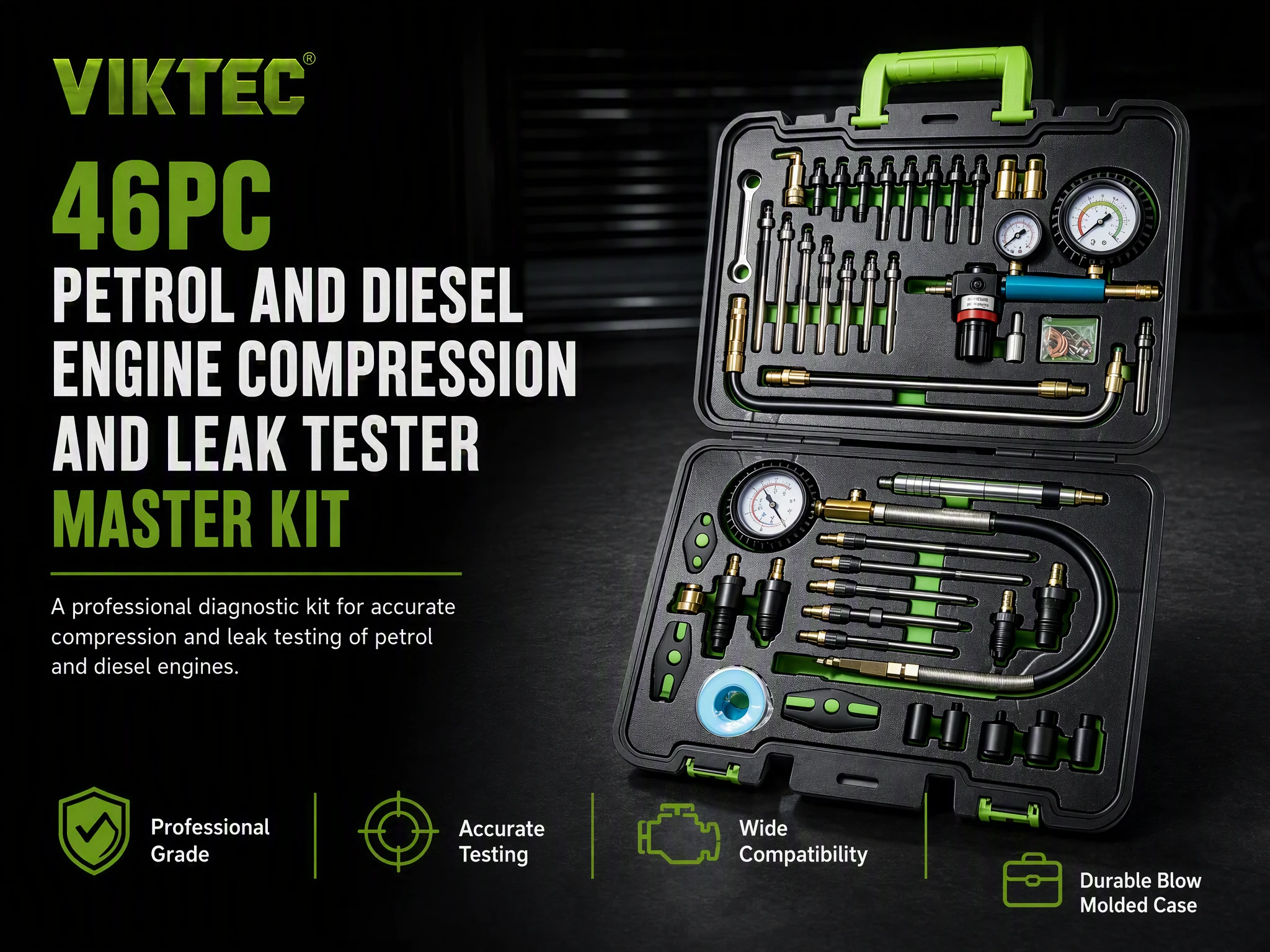
Record the result for every cylinder under the same conditions. Consistency is essential. Compare cylinder-to-cylinder variation rather than relying on only one reading. The kit’s quick-connect design helps technicians change adaptors efficiently, while the padded gauges and internal foam case protect sensitive components during storage and transportation.
How Do I Test If My Head Gasket Is Leaking?
A leak-down test can provide strong evidence of a head-gasket leak, but the result should be confirmed with related checks. Position the suspect cylinder at top dead center on its compression stroke, connect the tester, and apply regulated air.
Remove the radiator or expansion-tank cap only when the cooling system is safe and depressurized. Continuous bubbles appearing in the coolant while the cylinder is pressurized may indicate that air is passing from the combustion chamber into the cooling system.
Common Signs of a Head-Gasket Leak
- Continuous bubbles in the coolant: Pressurized air may be entering the cooling system.
- Unexplained coolant loss: Coolant may be entering the combustion chamber.
- Engine overheating: Combustion gases can disrupt cooling-system operation.
- White exhaust smoke: Coolant may be burned inside the cylinder.
- Adjacent weak cylinders: Leakage may be occurring between two neighboring cylinders.
- Oil and coolant contamination: A damaged gasket may allow fluids to mix.
No single symptom proves the diagnosis. A complete inspection may also include a cooling-system pressure test, a combustion-gas block test, compression comparison, and visual inspection.
The main advantage of leak-down testing is localization. Instead of only showing that a cylinder is weak, it helps the technician determine whether the leakage path is through the valves, piston rings, head gasket, cylinder head, or cylinder wall.
What Are the Three Types of Leak Detection?
Leak detection is commonly divided into three practical methods: pressure-decay testing, flow-measurement testing, and tracer or bubble detection.
1. Pressure-Decay Testing
Pressure-decay testing seals a system, applies pressure, and monitors whether the pressure decreases over time. It is suitable for closed components, hoses, cooling systems, and pneumatic circuits. However, it may confirm that leakage exists without showing its exact location.
2. Flow-Measurement Testing
Flow-measurement testing measures the amount of air or gas escaping while controlled pressure is maintained. An engine cylinder leak-down tester uses this principle. The twin gauges show the regulated supply condition and relative leakage, allowing technicians to compare cylinders and identify mechanical sealing problems.
3. Tracer or Bubble Detection
Tracer or bubble detection uses a visible or detectable medium. Examples include applying leak-detection fluid to a pressurized connection, observing bubbles in coolant, or using gas-sensitive test fluid to identify combustion gases. This method helps locate the physical leak, but sensitivity depends on the test medium and leakage path.
| Leak Detection Type | Core Principle | Typical Automotive Use | Key Strength |
|---|---|---|---|
| Pressure Decay | Measures pressure loss in a sealed system | Cooling systems, hoses, and sealed components | Simple pass-and-compare method |
| Flow Measurement | Measures escaping air while pressure is maintained | Cylinder leak-down diagnosis | Shows relative leakage and supports fault localization |
| Tracer or Bubble Detection | Uses bubbles, dye, or detectable gas | Connections, coolant leaks, and combustion-gas checks | Helps identify the physical leak location |
How Accurate Is a Leak-Down Tester?
A leak-down tester can provide highly repeatable workshop results when the equipment is in good condition and the procedure is controlled. Accuracy depends on more than the gauge itself.
The air regulator must provide a stable input, the piston must remain at top dead center, both valves must be fully closed, and the adaptor must seal correctly. Engine temperature, carbon deposits, hose leakage, and operator technique can also affect the reading.
Factors That Affect Test Accuracy
- Stable input pressure
- Correct top dead center positioning
- Fully closed intake and exhaust valves
- Correctly sealed adaptor and hose connections
- Consistent engine temperature
- Clean and calibrated gauges
- Consistent testing procedure
Leakage percentages should not be treated as a universal specification across every tester. Different gauge designs, orifice sizes, regulators, and calibration methods may produce different numerical readings on the same cylinder.
For reliable diagnosis, use the same tester, the same input setting, and the same test sequence across all cylinders. Compare cylinder balance and listen for the leakage path.
The 46PC master kit uses easy-read padded gauges, a twin-gauge leak-back configuration, and multiple adaptors for modern and older petrol and diesel engines. It supports applications including HDi, TDCi, Pumpe Duse, clamp-on injector, and Stanadyne injector arrangements.
Why Choose a 46PC Petrol and Diesel Master Kit?
For distributors and professional repair-tool buyers, adaptor coverage is as important as the gauges. This kit is designed for a wide range of cars, trucks, buses, agricultural machines, and marine engines.
Applications include Alfa Romeo, BMW, Chrysler, Daewoo, Fiat, Ford, Hyundai, Isuzu, Land Rover, LDV, Mazda, Mercedes-Benz, Mitsubishi, Nissan, Opel, PSA, Renault, Saab, Suzuki, Toyota, VAG, Vauxhall, and Volvo.
- Combined diagnosis: Supports both cylinder compression and leakage testing.
- Petrol and diesel coverage: Reduces the need to purchase separate basic kits.
- Extensive adaptor selection: Supports multiple spark-plug, glow-plug, and injector interfaces.
- Quick-connect fittings: Improve workshop efficiency and adaptor replacement.
- Easy-read gauges: Help technicians monitor pressure and leakage results.
- Protective storage: Internal foam padding protects gauges, hoses, and fittings.
- Professional sourcing options: Available with Customizable packaging, OEM branding, and ODM services.
As an experienced automotive repair tool Manufacturer and Supplier, VIKTEC can support product labeling, case design, instruction manuals, packaging, and distributor programs according to different market requirements.
Get Reliable Engine Diagnostics with the Right Tester Kit
The 46PC Petrol and Diesel Engine Compression and Leak Tester Master Kit helps workshops identify cylinder sealing faults faster and reduce unnecessary disassembly. Contact VIKTEC for specifications, wholesale pricing, Customizable packaging, OEM or ODM service, and distributor cooperation.