A blind-hole bearing puller needs more than a collet that fits through the bearing bore. Its gripping profile must engage the bearing as intended, the extractor must reach that engagement point, and the pulling system must have enough working space. Check those three conditions before comparing the number of collets in a kit.
This guide is for tool importers, distributors and workshop buyers selecting internal extraction equipment for automotive service. It focuses on recessed bearings with access from one side. It does not treat every internal bearing, plain bush or damaged outer race as the same application: the part remaining in the housing determines which extractor design can work.
Identify what the extractor can actually grip
“Blind hole” describes an access problem. The component is recessed and cannot simply be driven out from the opposite side. It does not establish that every expanding collet will engage it. A bearing may sit against a shoulder, have limited space behind its inner ring, or be damaged so that the normal gripping surface is missing.
Start with a photograph of the complete assembly and a close-up of the bore. Record whether the inner ring is intact, whether the bearing is retained mechanically, and whether the service procedure allows the intended extraction method. This information distinguishes a normal collet enquiry from a request for a more specialized extractor.
The KUKKO internal-pulling guide separates extractor styles and asks buyers to consider bore diameter and available support. That distinction is useful when screening kits: a shared diameter range does not make different gripping designs equivalent.
Complete bearing with an accessible bore
Review the collet’s working profile against the bearing geometry. Ask how the selected collet engages, what clearance it requires and whether the supplied instructions cover that bearing arrangement. Do not assume that expansion against any cylindrical surface creates an approved pulling connection.
Outer ring remaining after bearing damage
A kit intended to engage through an intact bearing bore may not address a remaining outer ring. Describe the damaged condition explicitly and request the appropriate tool design. Ordering a larger standard collet without identifying its contact surface can produce a kit that looks suitable on paper but has no reliable engagement in the assembly.
Plain bush or needle-bearing application
These components may require a different contact profile or extraction method. Keep them as separate lines in the application list. A distributor should avoid turning a broad “internal bearing puller” description into a promise that the kit covers every bush and needle bearing within the headline diameter range.
The measurement sheet that prevents most selection ambiguity
Request all measurements in one stated unit, normally millimetres for a metric kit. Annotate the photograph so the supplier can see where each dimension was taken. The useful depth is the distance to the intended engagement surface, not simply the overall depth of the empty housing.
| Measurement or observation | What it establishes | What it does not establish |
|---|---|---|
| Bearing bore diameter | Candidate collet size range | Engagement profile or permission to use that collet |
| Recess depth to the bearing | Required extractor access length | Available space behind the gripping surface |
| Clearance at the engagement area | Whether the intended lip or profile can locate | Load capacity of the complete arrangement |
| Housing opening and nearby obstacles | Access for extractor body and adapters | Suitability of the housing as a reaction support |
| Space along the pulling axis | Potential room for a slide hammer or bridge assembly | Approval of a particular drive method |
| Housing support surfaces | Possible locations for a counter-support design | Structural suitability without an application review |
For an illustrative enquiry, a buyer might record a 20 mm bore and a bearing positioned 45 mm below the opening. Those two figures narrow the search, but they do not establish a working tool. The supplier still needs the engagement geometry, access for the extractor body and the space available for the pulling assembly. These are example measurements, not VIKTEC product limits.
Read individual collet ranges instead of the case label
A kit advertised with a minimum and maximum diameter is not necessarily continuous between those endpoints. Request a table listing every collet, its marked size range and its part number. Read adjacent intervals individually, especially around the dimensions that appear most often in your customers’ work.
For example, BGS’s 15-piece blind-hole puller listing publishes separate spreader-claw ranges rather than just one overall size. Its listed components illustrate why an itemized range table is more informative than a piece count. That published assortment should not be assumed to describe another manufacturer’s kit.
Also distinguish a collet’s nominal range from the thread or adapter that connects it to the pulling mechanism. A replacement collet can have the desired bore range but an incompatible connection. Record both sets of information in the spare-parts list so the warehouse does not substitute parts by diameter alone.
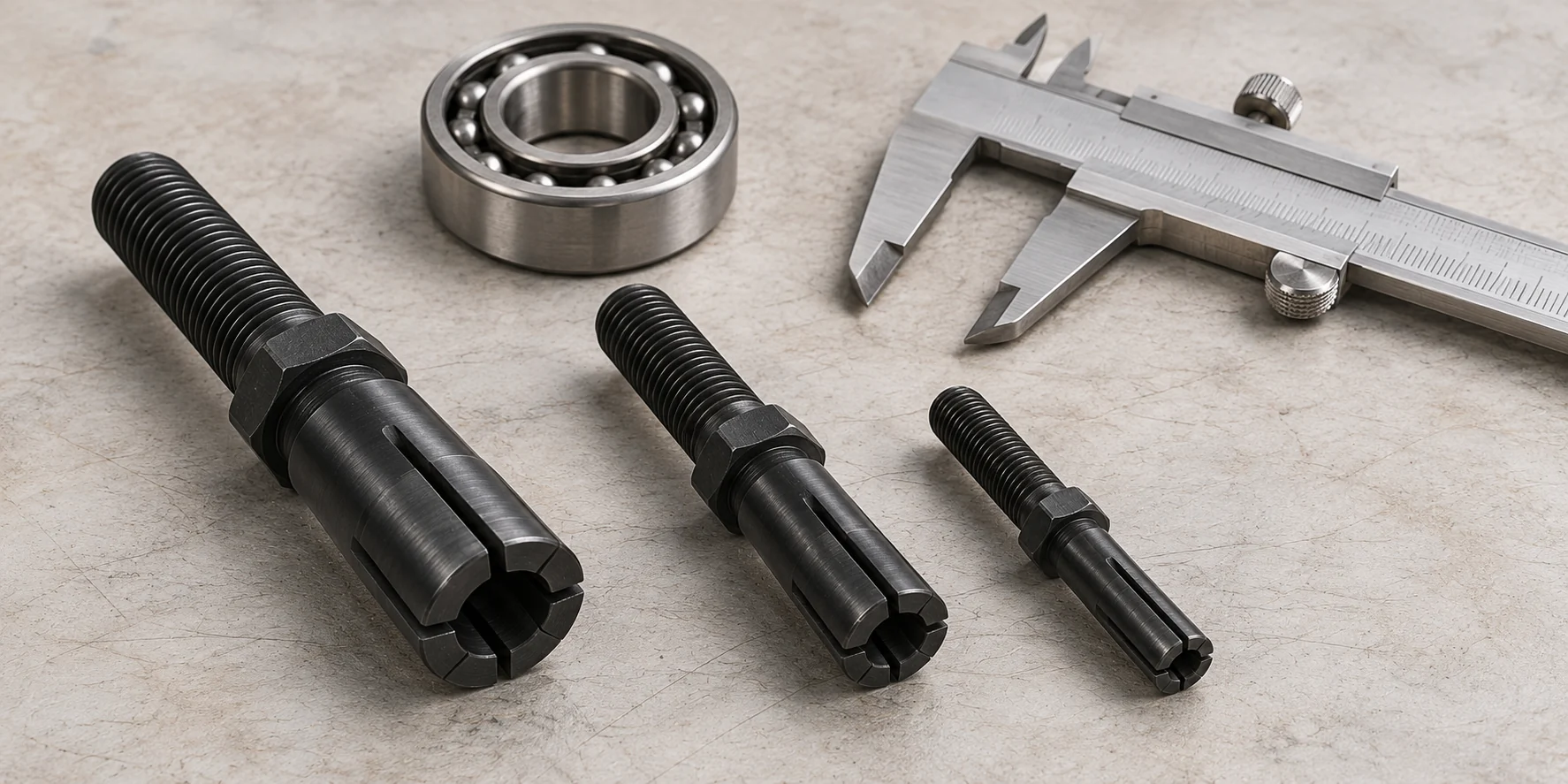
Slide hammer or bridge: choose around the available space
When considering a slide hammer
Ask for the assembled length and the space needed for its permitted working movement. The storage-case length is not that dimension. Obstacles can include a body panel, gearbox structure, workbench or another part of the assembly. A tool that enters the bearing bore may still be unusable once the pulling mechanism is attached.
Record the supplied hammer assembly and connection components, not just its mass. Do not infer extraction performance from weight alone or assume that a heavier hammer is a suitable upgrade for the same collet. The approved tool combination and the assembly’s service instructions govern the selection.
When considering a bridge or counter-support
A bridge arrangement needs appropriate support around the opening. Check the support span, contact geometry and screw travel against the actual housing. Thin covers, irregular castings and nearby projections can make a seemingly convenient surface unsuitable. A dimensioned photograph helps the supplier review this before the buyer commits to the kit.
KUKKO’s guide distinguishes the choice between a counter-support where a suitable supporting surface exists and a slide hammer where it does not. Treat that as an initial selection branch. The proposed tool and housing still need to be matched; the guide is not approval for placing bridge feet on any available edge.
Deep recesses need a complete extension specification
When a bearing sits deep in a housing, ask whether the chosen extractor has an approved extension. The enquiry should identify the collet, extension, connection adapters and pulling system together. Adding a longer threaded rod because it fits the connection does not establish compatibility or the permitted working limit.
Ask the supplier to show the assembled access length and the remaining operating envelope. A longer extractor can reach the bearing while leaving insufficient clearance for the slide hammer or bridge. Keep both dimensions in the application record. This also makes it easier to explain to a customer why an extension solves one problem but not necessarily the whole job.
For a distributor, separate standard kits from deep-access additions in the catalogue. Give the compatible base-kit references and the intended use of each addition. That is clearer than advertising a single broad “universal” range that conceals which extra components a customer must purchase.
Decide whether the removed bearing is to be replaced
Tell the supplier whether bearing preservation is part of the job. The ability to remove a component does not establish that it remains suitable for reuse. If the chosen method loads a bearing through surfaces not intended for that purpose, or the bearing was already damaged, a visually clean result is not sufficient evidence of serviceability.
For procurement, define the intended outcome in plain language: remove a bearing scheduled for replacement, recover a housing without damage, or perform another documented service task. Avoid asking for a general “damage-free removal” guarantee. The condition of the assembly and the specific method matter, and a tool supplier cannot validate an unknown bearing’s reuse condition from its bore size.
Plan replacement parts around the customer’s recurring sizes
Ask which collets, actuator components, adapters and pulling parts are available individually. Record part numbers rather than descriptions such as “small collet.” If a workshop repeatedly uses two sizes, those references deserve a different spare-parts review from the rarely used ends of the range.
Agree the inspection and maintenance instructions supplied with the kit. The buyer needs a clear route for identifying wear, damage or missing parts and obtaining the appropriate replacement. Do not create a field-repair instruction from a product photograph. Cleaning, lubrication and withdrawal criteria should come from the instructions for the actual tool.
For private-label distribution, make sure the proposed contents sheet, case identification and spare-parts references remain connected. Renaming a kit for a catalogue should not make its technical components untraceable. This is a documentation requirement to request, not an assumption that every branding option is available.
Review a sample against the intended application list
When comparing two quotations, mark which recurring bore sizes have a specified collet and which still need clarification. Then check the access length and pulling mechanism for those same applications. This two-pass comparison prevents a broad diameter range from hiding a shallow-access limitation. It also gives the supplier a short, concrete list of unresolved applications instead of an open-ended request to confirm universal coverage.
Use an agreed sample inspection to verify what the quotation describes. Reconcile the physical contents with the component list, inspect the size markings, and confirm that the instructions explain the supplied connection system. Record any separate equipment required for the proposed application.
Where a functional evaluation is appropriate, have it performed by qualified personnel using the documented procedure and a representative assembly. Record the application and configuration, including any approved extension. A successful evaluation on one bearing is evidence about that combination; it is not proof of coverage for every bore size printed on the case.
The VIKTEC 11-piece blind-hole bearing puller set is a relevant product to include in an enquiry. Compare its current contents with your application sheet and, if the requirement includes other engagement types, review the wider bearing puller range.
Questions that come up after the first shortlist
Can the same collet work with a different brand of slide hammer?
Do not assume compatibility from a thread that appears to match. The connection, thread engagement and complete assembly must be approved for that combination. Send both tool references and request written compatibility information. An adapter that joins two parts physically does not establish their permitted use together.
Does a larger kit automatically reduce the need for special tools?
No. Additional collets may widen the diameter selection while leaving the same engagement profile and access limitations. Compare the extra components with the jobs that the smaller kit cannot cover. Buy additional capability that solves a documented gap, rather than relying on the total piece count.
What if the customer has only a bearing number?
The bearing number is a useful starting point, but request photographs and housing dimensions as well. The same bearing can be installed in assemblies with different access and support conditions. A replacement-part catalogue does not normally describe the full tool working envelope.
What information should accompany a quotation request?
Include bearing identification, measured bore and recess depth, engagement photographs, available pulling space, expected quantities and destination market. State whether a slide hammer, bridge or both are required. Request a blind-hole puller quotation with your application measurements so the enquiry can be reviewed against a defined configuration.