Choose a wheel bearing press kit by the bearing assembly, the surfaces that must carry the pressing load, and the space available for the complete tool. A useful kit must provide suitable driving and receiving components for each required operation. Its piece count and largest disc diameter are only inventory information; neither proves vehicle coverage.
For a distributor or workshop buyer, the strongest starting point is an application list: which bearing designs, which vehicles and which service methods must the kit support? This guide turns that list into dimensions and purchasing checks. It addresses tool selection for press-fit bearing work, not a universal replacement procedure for every wheel hub.
First identify the bearing assembly the customer services
A vehicle description alone can leave several possibilities. The bearing may be a separate cartridge pressed into a knuckle, part of a bolted hub assembly, or a design that requires dedicated tooling. A generic wheel bearing press kit should not be advertised as suitable for all of these simply because they are wheel bearings.
Ask for the bearing or hub part reference and the vehicle’s model, year, axle position and relevant variant. Then identify the removal and installation method in the applicable service information. This keeps the tool enquiry tied to a real operation rather than a broad vehicle name that may cover different assemblies.
For a range overview, VIKTEC bearing press tools provide a starting point for comparing kit formats. Keep product-category browsing separate from application confirmation: the latter requires the actual components and dimensions.
Map the load path before choosing the discs
The driver must transmit force to the correct bearing ring for the particular mounting operation, while the supporting tooling provides a suitable reaction path. In a conventional interference-fit mounting, force should not be transmitted through the rolling elements to move the ring being fitted. NSK’s mounting guidance explains the distinction between pressing a bearing onto a shaft and mounting it into a housing.
For the wheel-bearing example documented in NSK’s replacement guide, fitting the bearing into the knuckle and fitting the hub involve different ring contacts. The buying implication is straightforward: a kit that supplies an appropriate disc for one stage may still lack the support required for the next.
| Operation to document | Tooling information to request | Common purchasing gap |
|---|---|---|
| Remove the old bearing | Approved pushing surface, receiving cup and clearance for the extracted part | A receiver that fits around the bore but lacks useful depth |
| Install the bearing in the housing | Driver profile for the fitted ring and a suitable housing support arrangement | A disc selected only by its outside diameter |
| Fit the hub to the bearing assembly | Support and driver arrangement specified for that assembly | Assuming the previous stack can simply be reversed |
| Service a different bearing generation | Application-specific adapters and instructions where required | Extending generic kit coverage without evidence |
Ask the supplier to show the proposed stack for each operation with identifiable component references. A drawing or clear application photograph can reveal a missing support ring more effectively than a long statement that the kit is suitable for professional use.
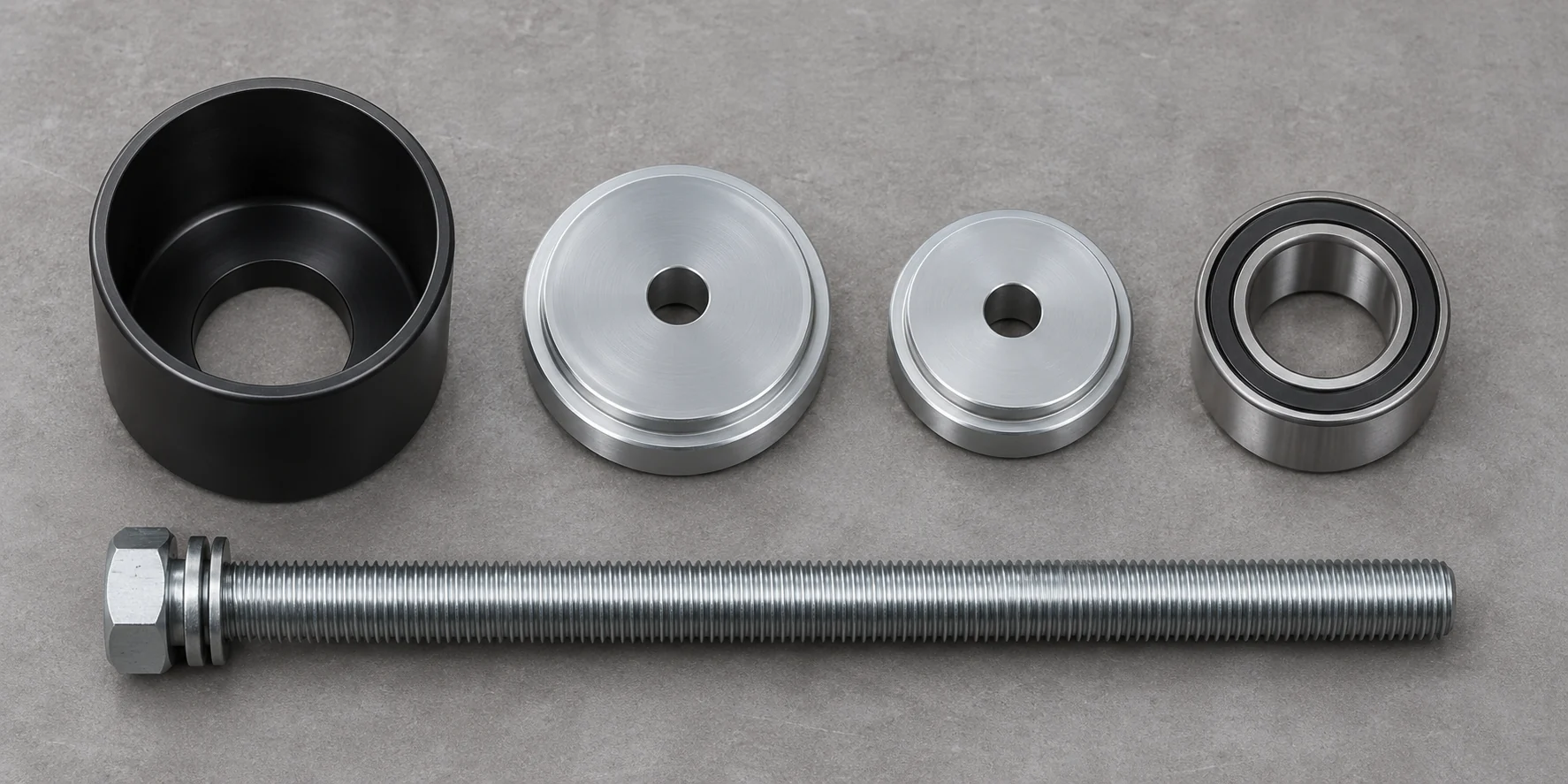
Measure the receiving cup in three directions
A receiver needs sufficient internal clearance for the component entering it, sufficient usable depth for the required movement, and a contact rim that can react against the intended support area. These are separate dimensions. A larger receiver may solve an internal-clearance problem while moving its support rim onto an unsuitable part of the assembly.
Internal diameter
Record the maximum diameter of the part that must enter the cup, including any flange or projection relevant to the chosen direction of travel. Compare it with the receiver’s usable bore, not only its nominal description. Ask for the actual drawing if the inside profile changes along its depth.
Usable depth
Measure the space inside the assembled receiver after accounting for its base, adapters and any central hardware. Overall cup length can overstate the space available to the extracted component. The supplier should confirm that the proposed combination permits the complete required movement.
Supporting face
Identify the surface the cup will bear against. Check its width, flatness and clearance around nearby cast features in the context of the specified service method. Do not treat a cup that merely sits around the bearing as an approved support fixture. A picture of the housing from both sides is valuable here.
A driver disc needs a contact profile, not just a diameter
A disc can be too large to pass into the available space or too small to contact the intended ring properly. Its centre opening, recesses and stepped surfaces can also matter. Ask the supplier to identify which face is used for the target operation and how that face locates on the component.
Where several discs have similar diameters, assign them distinct references in the application sheet. Avoid instructions such as “use the nearest size.” The purpose of the measurement review is to choose an approved fit, not to encourage the technician to improvise under load.
For a distributor’s catalogue, publish the dimensions that the customer actually uses. A list of disc diameters is useful; a labelled diagram explaining which diameter is being reported is better. Keep the supplied dimensions separate from any vehicle-fitment claims that require additional evidence.
Check the spindle, thrust components and drive method as a set
For a screw-operated kit, request the spindle specification, matching nuts, thrust components and adapter interfaces. Thread diameter by itself does not establish interchangeability. The length of the assembled stack also affects available travel and engagement, so a replacement screw should not be selected solely because it passes through the plates.
Ask whether replacement force screws, nuts and thrust bearings are available and how they are identified. These are practical after-sales questions for a workshop tool range. The response should become part of the purchasing record rather than an assumption made from another manufacturer’s kit.
Confirm the permitted drive method in the tool instructions. A hexagonal drive does not prove compatibility with an impact wrench. If the customer requires powered operation, make that a selection criterion at the beginning rather than a feature added to the catalogue after purchase.
On-vehicle kit or workshop press accessories?
An on-vehicle arrangement may avoid some disassembly where the vehicle procedure and available access permit it. A workshop press arrangement moves the assembly to a different working environment but still needs suitable support tooling. Neither description alone establishes that the complete bearing service is possible.
For a workshop chain, compare the full service route. Record access preparation, removal of surrounding components, tooling setup, pressing stages and reassembly requirements. A portable kit that appears faster in isolation may not be the best choice if the intended vehicle requires substantial preparation anyway.
For a distributor, distinguish complete screw-operated systems from adapter assortments intended for use with separate equipment. State what the customer must already have. A lower quotation for adapters alone should not be compared directly with a complete extraction and installation kit.
Build a purchasing worksheet around your priority applications
Start with the applications that represent the intended customer demand. Do not ask a supplier to confirm every passenger vehicle without a defined list. The following worksheet provides a consistent basis for comparing candidate kits and identifying where dedicated additions may be required.
| Worksheet field | Buyer supplies | Supplier response requested |
|---|---|---|
| Assembly identity | Vehicle details, axle position and bearing or hub reference | Applicable kit and any exclusions |
| Removal arrangement | Required service method and housing photographs | Receiver and driver references |
| Installation arrangement | Bearing design and prescribed support requirements | Complete adapter stack for each stage |
| Available space | Access dimensions and obstructions | Assembled tool dimensions and travel |
| Workshop equipment | Existing press or preferred drive system | Compatibility and additional equipment required |
| Commercial scope | Order quantity and destination market | Itemized contents, documents and replacement-part options |
Keep unanswered application lines separate from confirmed coverage. This is useful commercial information: it tells the buyer whether to select another kit, add a dedicated tool or narrow the catalogue description. A broad claim that cannot be mapped to components is less useful than a smaller, clearly documented range.
Use piece count to check completeness, not capability
A simple coverage comparison for two candidate kits
Suppose a workshop’s shortlist contains three priority bearing assemblies. Kit A has more components, but the supplier provides a complete documented removal and installation arrangement for only two. Kit B has fewer components and an approved arrangement for all three. On that evidence, Kit B has better coverage of the stated requirement, even though its case is smaller. This is a hypothetical comparison, not a test of named products.
The unresolved application in Kit A should be priced as a gap: ask whether a dedicated addition is available, what it includes, and whether it requires different equipment. Compare the revised total scope before making the purchase decision. If no suitable addition is documented, keep that application outside the kit’s coverage instead of counting it as an assumed future capability.
For distributors, the same method can be applied to customer segments. A passenger-car workshop and a mixed commercial-vehicle repairer may have different priority lists, so one headline kit ranking is unlikely to serve both well.
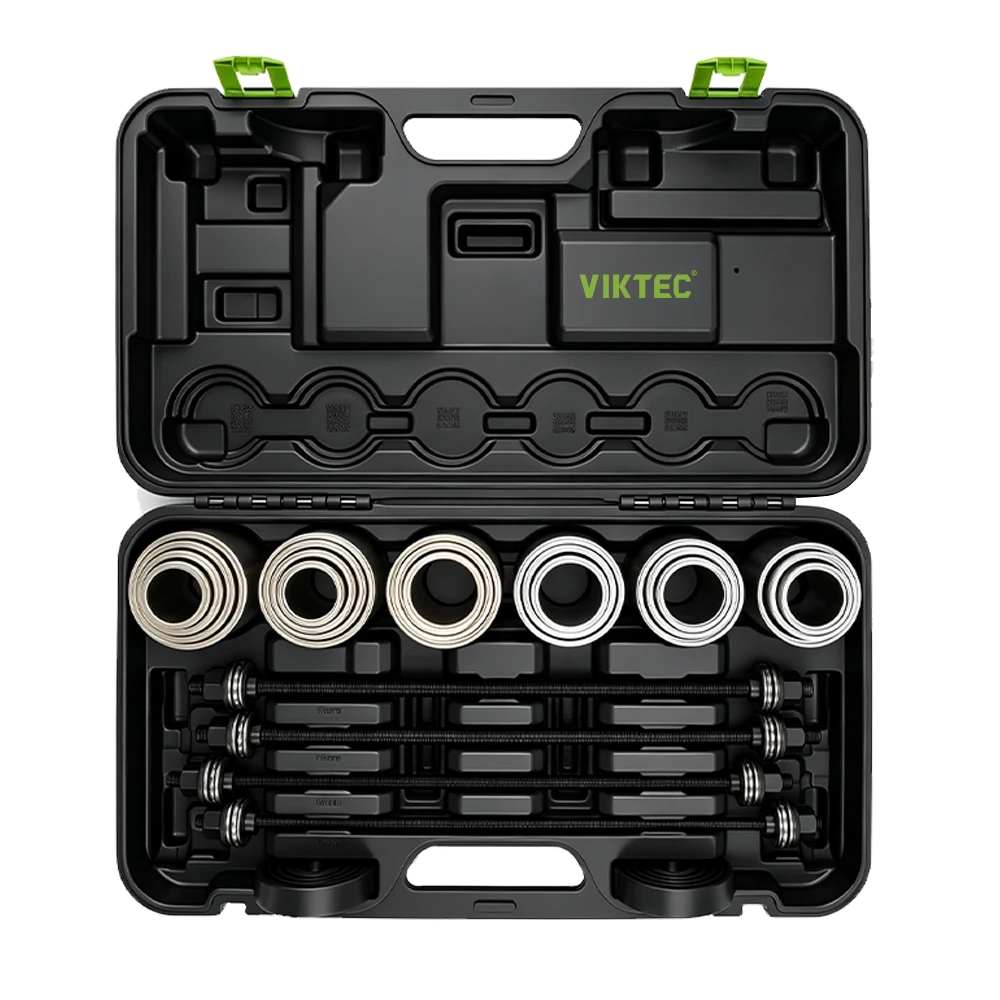
A 31-piece kit may include plates, sleeves, fasteners and other components with different functions. Another kit with fewer pieces may cover a particular application equally well, while a larger case may still omit a required adapter. Compare unique working functions and dimensions instead of ranking kits by the number printed on the package.
The VIKTEC 31-piece wheel bearing removal and installation kit is one product to review against the worksheet. Ask for its current component list and the dimensions relevant to your applications. The product name should not be expanded into an unrestricted vehicle-coverage claim.
Before approving an order, reconcile the quotation, sample, instructions and case inventory. Make sure the sample’s parts can be identified in the documentation. If an application demonstration is arranged, retain the assembly details and tool configuration alongside the result; one successful demonstration does not validate unrelated vehicles.
Questions from workshop and trade buyers
Can a bearing press kit also install oil seals?
Some assortments include components suitable for specified seal work, but bearing and seal contact requirements are different. Confirm the intended seal design, driving face and approved procedure. Do not assume every flat bearing disc is a suitable seal installer simply because its diameter is close.
Does a hydraulic workshop press eliminate the need for a screw-operated kit?
Not necessarily. The two arrangements may serve different access and workflow needs. A press still requires appropriate supporting and driving tooling, while a portable kit must fit the assembly in its working location. Select around the jobs and available equipment rather than treating one machine as a universal replacement for all adapters.
What does “universal” mean in a tool listing?
It normally indicates an adaptable assortment rather than guaranteed coverage of every vehicle. Read the supplied component dimensions and application information. For a trade catalogue, describe the actual range and any dedicated additions instead of using “universal” as an unqualified fitment promise.
What should be sent when requesting a quotation?
Send the priority vehicle and bearing references, required service stages, available equipment, relevant measurements and planned quantities. Include any documentation or packaging requirements as part of the enquiry. Request a wheel bearing tool quotation for your application list to compare the proposed kit against a defined purchasing requirement.