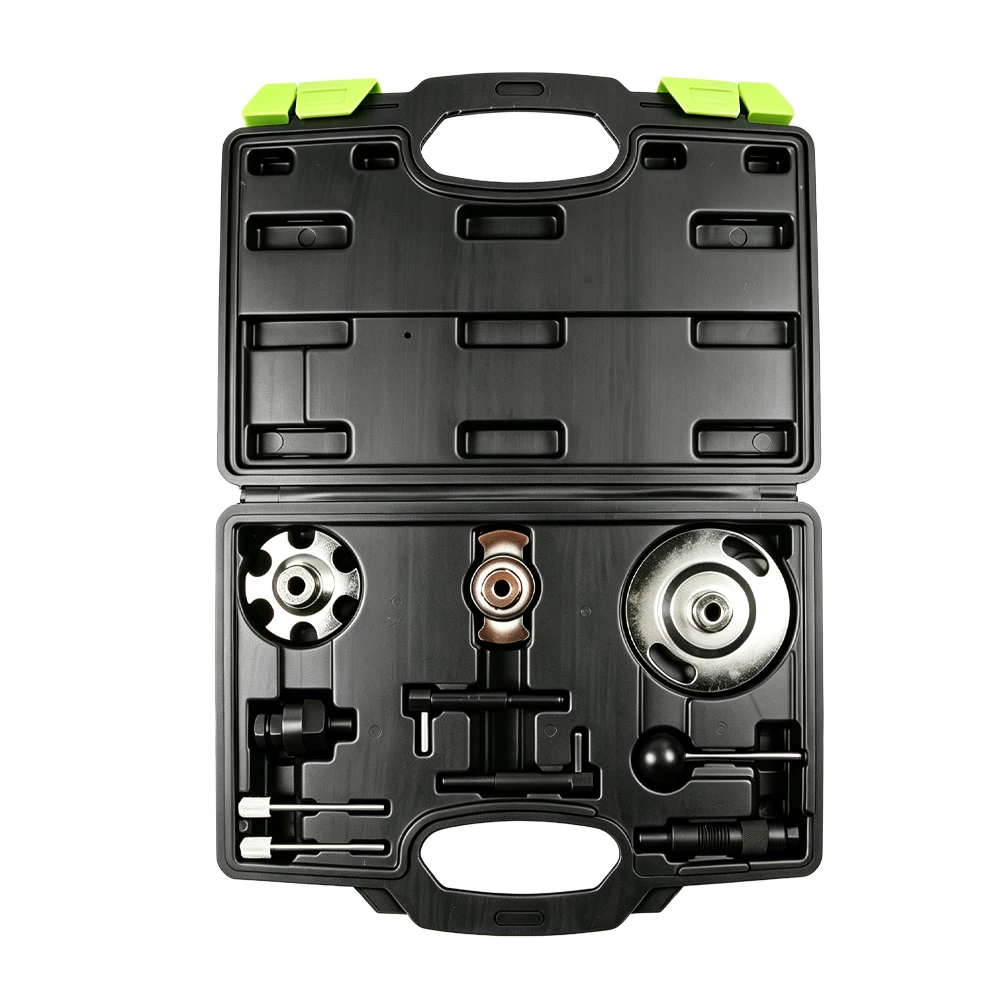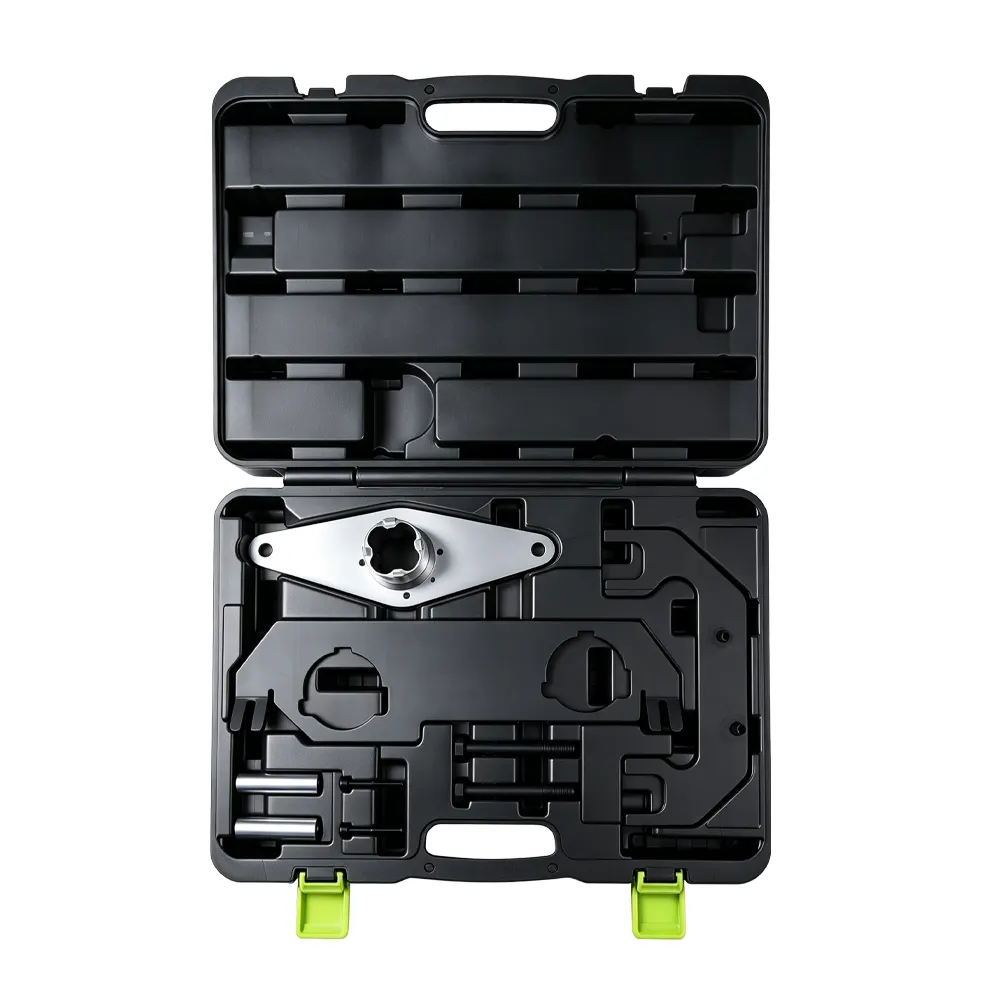
A ball joint press can be used for a control arm bushing only when the frame, adapters, contact surfaces and operating method are suitable for that specific bushing application. A C-frame that fits around the arm is not enough. The complete arrangement must be supported by the tool instructions or an application-specific approval.
For buyers, this is a compatibility decision rather than a simple choice between two product names. Reusing a frame may reduce duplicated equipment, but only if the required bushing adapters and documentation exist. Otherwise, a dedicated bushing tool can be the more appropriate purchase even when a ball joint press is already available.
The shared C-frame does not make the jobs identical
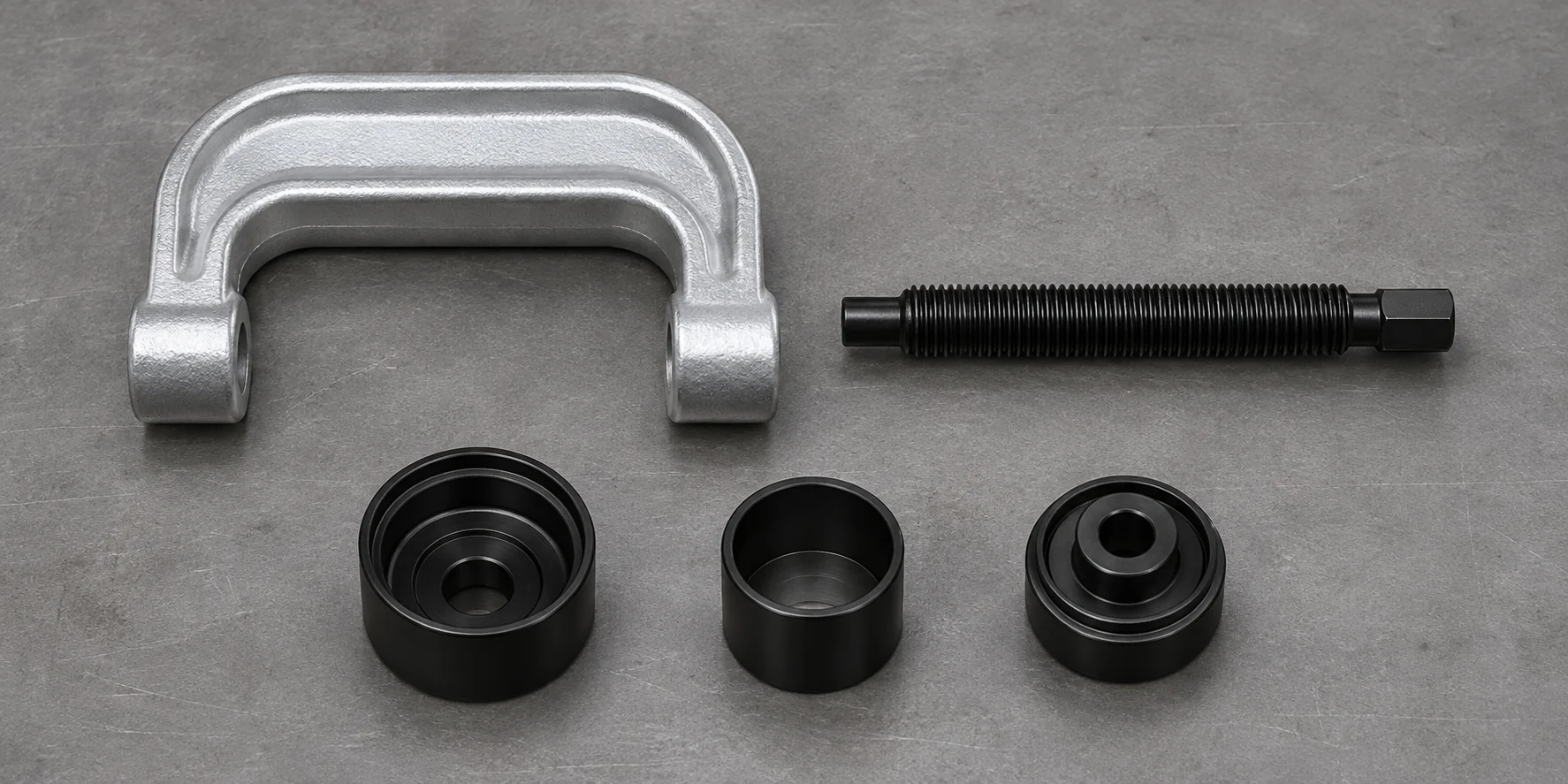
A ball joint press is commonly associated with removing and installing a press-fit joint housing. A bushing service system may also use a C-frame, but its adapters must suit the bushing and the surrounding arm. The frame supplies part of the force system; it does not determine the correct contact profile by itself.
OTC’s upper control arm bushing service set provides a useful example: it combines a C-frame and screw assembly with adapters for a defined bushing application group. The existence of that system shows why the question should be “which approved frame-and-adapter combination?” rather than “will any ball joint press do?”
In a catalogue, keep the distinction visible. A ball joint kit, a dedicated bushing kit and an adapter-only expansion set are different purchasing scopes. If a customer already owns a frame, identify its model before recommending an adapter set. Similar appearance or a shared nominal frame size does not establish compatibility.
A five-gate check for reusing the frame
Use these gates in order. A failure at one gate is a reason to change the proposed configuration, not to compensate with more force at a later stage. The checklist is a purchasing review; it does not authorize a technician to improvise an undocumented service method.
1. Is the bushing intended to be serviced this way?
Identify the bushing design, replacement-part reference and permitted repair route. A bonded shell-type bushing, a hydraulic bushing and a multi-piece replacement may require different tooling. Confirm whether the service information allows separate bushing replacement and whether the proposed method matches that design.
Also identify the arm condition. A tool quotation cannot establish that a cracked, distorted or otherwise unserviceable arm should be reused. The repair professional must decide whether the component is suitable for the intended work before the tooling decision becomes relevant.
2. Can the complete stack fit within the opening?
The stack includes the bushing and arm section, driving adapter, receiving component, locating parts and any required clearance. Compare that assembled dimension with the frame’s usable opening in the intended position. The empty-frame opening alone is not a complete fit check.
As a hypothetical screening example, an 80 mm assembly plus a 40 mm receiver and a 20 mm driver already accounts for 140 mm before any additional locating components or operating requirements. These numbers are not tool specifications. They show why measuring only the bushing length can lead to an incorrect shortlist.
3. Does the throat reach the correct force axis?
Frame opening and throat depth answer different questions. The opening accommodates the stack; throat reach determines whether the frame can reach over surrounding arm geometry while aligning with the bushing axis. A frame may have ample opening but still be obstructed by the arm.
Request a side-view photograph or drawing showing the complete arrangement. Check clearance throughout the intended movement, not just at the starting position. If access requires the frame to sit at an angle that the approved setup does not allow, the proposed combination is unsuitable.
4. Do the adapters contact and support the intended surfaces?
Check the driving face against the bushing construction and the receiving face against the arm. A cup that clears the outside of the bush may still support the wrong part of the arm. An adapter that touches the centre sleeve may not perform the intended job on the complete bushing.
Require identifiable adapter references and an application drawing. The useful evidence is the manufacturer’s specified arrangement, not a photograph of loose cups that happen to fit inside one another. For both removal and installation, the support and contact surfaces need to be understood separately.
5. Is the assembled system approved for the load and drive?
Confirm the operating limits and permitted drive method for the actual frame, screw and adapters. Do not transfer a rating from one component to the entire stack. The strongest-looking frame cannot validate an unknown receiver, improvised spacer or incompatible forcing screw.
If the supplier cannot establish the combination, ask for a dedicated bushing arrangement. A written compatibility statement should identify the relevant models or part numbers and any conditions, rather than simply saying that the accessories are “universal.”
Compare the alternatives on the same job
| Option | When to consider it | What must be established | What to include in the quotation |
|---|---|---|---|
| Existing C-frame with approved bushing adapters | The buyer already owns a compatible frame | Frame identity, application, stack dimensions and documented combination | Adapter set, required additional parts and instructions |
| Dedicated C-frame bushing kit | A defined application group needs a complete system | Coverage and access for the intended arms | Frame, force components, adapters and replacement-part references |
| Draw-through bushing tool | The approved application permits a through-screw layout | Screw passage, support surfaces, receiving space and operating envelope | Matched screw, cups, nuts, thrust parts and any application adapters |
| Bench press tooling | The service route calls for off-vehicle work | Suitable fixtures, contact arrangement and press compatibility | Adapters and fixtures plus separately required equipment |
This comparison avoids a common purchasing error: comparing an adapter-only price with the cost of a complete kit. Identify what the workshop already owns and what it still needs. The least expensive quotation may be the right choice, but only after the scope has been made equivalent.
When a dedicated bushing tool is the better enquiry
Move toward a dedicated tool when the bushing requires a shaped contact face, a split support, a controlled orientation or access that the available C-frame cannot provide. These are geometry and procedure issues. Increasing frame size may not solve them and can make the working envelope less convenient.
A draw-through layout may be worth evaluating where the arm geometry blocks a C-frame but the documented service method permits access along the bushing axis. Conversely, an obstructed centre can make that route unsuitable. Neither design is automatically more versatile; each needs a match to the actual assembly.
Repeated work on one vehicle family may justify a dedicated tool even when a broader kit can cover the job. To evaluate that choice, compare identification, setup and component handling during a qualified sample assessment. Do not assume a time saving simply because the tool is vehicle-specific.
For occasional applications, an approved expansion set may be a reasonable way to extend existing equipment. Confirm replacement-part access and keep the instructions with the base kit. An accessory that becomes separated from its compatibility information can create confusion later, especially across multiple workshop locations.
Separate removal compatibility from installation compatibility
A setup that removes the old bushing does not automatically establish how the replacement should be installed. The new component may have an orientation requirement, an insertion profile or a specified final position. Ask the supplier to show both arrangements and identify any components used only during installation.
Do not accept “reverse the procedure” as the entire application explanation when the contact faces change. A useful diagram shows the driver, receiver, arm and bushing in the relevant order. It also makes clear which components must remain clear of the centre sleeve or other projections.
For a distributor, publish compatibility by service function where necessary. A kit that covers removal but needs an additional installation adapter should be described that way. Clear scope helps the customer plan the complete job and reduces avoidable follow-up orders.
Build a compatibility record that survives repeat orders
Record the base-frame model, force-screw reference, adapter references and application identity in one document. Attach the approved drawing and instruction version. This creates a useful record for replacement purchases and prevents a later buyer from substituting a visually similar component without review.
The record should also identify exclusions: unsupported arm positions, different chassis generations, or configurations requiring another adapter. An exclusion is useful information for the customer. It is more reliable than stretching a broad description to cover an application that has not been checked.
Where several workshops share the same equipment, use consistent component names in stock records and training materials. “Large cup” is not a stable identifier. A part reference tied to its dimensions and compatible tool system is much more useful when replacing a lost receiver.
Assess the cost of an expansion set honestly
Separate three possible outcomes in the compatibility record: the existing system is documented as suitable; it becomes suitable with specified additions; or the proposed combination is unsupported. Only the first two provide a basis for an equipment comparison. The third is not a cheaper option awaiting a clever setup; it is a different sourcing problem that needs an appropriate tool.
Make the outcome understandable to purchasing staff who did not attend the technical review. A list of part numbers and a referenced drawing is more useful than a note saying “should fit.” This reduces the chance that a later replacement purchase loses the conditions under which the original combination was accepted.
Compare the purchase price of the additional adapters with the complete alternative, then include the parts and documentation needed to make each option usable. Also consider whether the existing frame must remain available for other jobs. Sharing one frame can reduce duplicated equipment but can also create a scheduling constraint in a busy workshop.
Use the workshop’s own workload information for that decision. No universal payback period can be inferred from the number of pieces in a kit. A fleet with repeated work on one assembly may value a dedicated setup differently from a general repair shop handling occasional, varied applications.
Review VIKTEC ball joint service tools alongside the bushing removal and installation range. The categories provide alternative enquiry routes. They do not imply that every component in one range can be combined with the other.
Questions about sharing ball-joint and bushing tooling
Can ordinary sockets be used instead of receiving cups?
Do not specify ordinary sockets as substitutes for dedicated press adapters unless their manufacturer explicitly approves that use in the system. Physical fit is not evidence of suitable support geometry or loading capability. Request the intended receiver or an approved replacement.
Can a bigger C-frame solve a lack of clearance?
It may solve an opening or reach problem, but it can also introduce a larger external envelope. Check the complete arrangement against the arm and surrounding components. Size alone does not correct an unsuitable contact face or establish application approval.
Does a successful trial prove broad vehicle coverage?
No. It provides information about the recorded application and configuration. Other vehicles may use different bushings, arms or access arrangements. Expand the coverage list only when the relevant applications have been reviewed.
What should be sent to check an existing frame?
Send its manufacturer, model and component references, clear photographs, opening and throat dimensions, and the target bushing details. Include the desired quantities and any missing adapters. Ask VIKTEC to review your bushing-tool requirement before selecting a complete kit or an application-specific alternative.