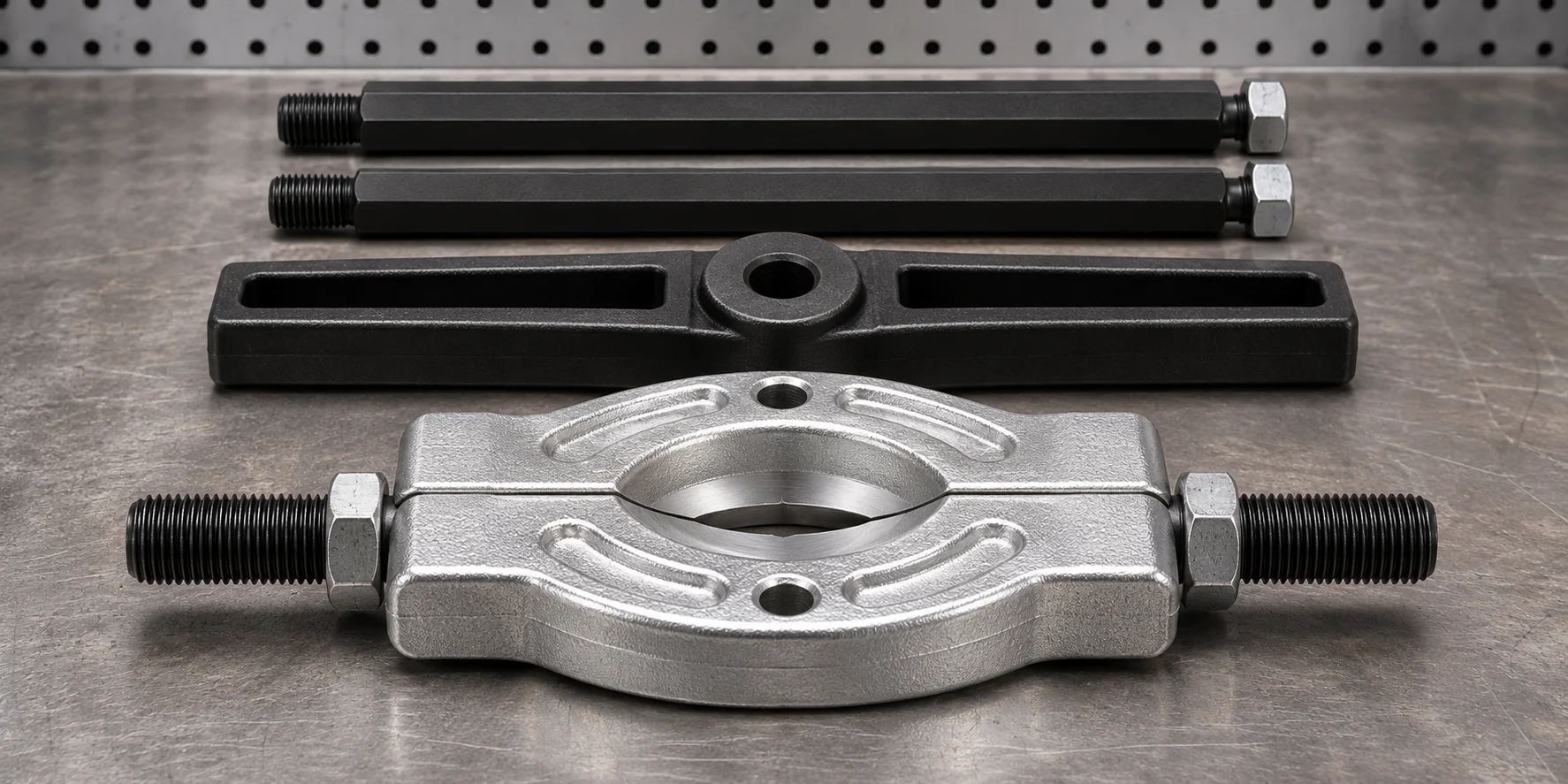
A bearing separator provides a gripping or support surface behind a bearing or similar component. A puller supplies the arrangement that draws the component away from its seat. They are often used together: a separator, connecting rods, crossbar and forcing screw can form a complete separator puller.
When buyers compare a bearing separator with a jaw puller, the real question is usually about access. Can jaws reach a sound rear face, or does the job need the narrower entry and different support geometry of a split separator?
Why a separator can fit where jaws cannot
A conventional jaw tip needs enough space behind the component to seat securely. A bearing positioned close to a shoulder may leave too little room. A split separator approaches from the sides and presents a tapered inner edge, potentially giving access where a thicker jaw cannot enter.
That possibility has limits. A separator cannot make an inaccessible or unsuitable contact surface safe. Confirm where its edge will bear and whether the component construction permits that loading. Thin shields, seals and fragile edges are not interchangeable with a solid bearing ring.
SKF’s strong-back puller documentation treats the separator, beam, rods and spindle as a specified system. It also lists reach and shaft-diameter ranges separately. This is a useful way to evaluate a kit without assuming that the separator’s opening tells the whole story.
Compare the two arrangements
| Issue | Jaw puller | Separator puller |
|---|---|---|
| Initial access | Jaw tips approach the rear gripping face | Split plates approach around the component |
| Contact geometry | Discrete jaw contact points | Contact formed by the separator’s inner edges/faces |
| Working length | Limited by jaw reach and spindle arrangement | Depends on rods, crossbar and approved extensions |
| Common purchasing omission | Insufficient jaw-tip clearance | Missing or incompatible rods, bridge or spindle |
| Useful evidence | Jaw dimensions and illustrated working positions | Separator profile and complete assembly drawing |
Four dimensions to confirm before ordering
Opening range
Check the separator’s permitted working opening against the actual component. Do not infer the opening from the overall width of the plates. Confirm how the range is measured and what contact remains near its limits.
Entry clearance and contact profile
A front photograph conceals the thickness and shape of the edge. Request a side view or drawing. Also check whether surrounding flanges allow both halves to be positioned without interference.
Rod spacing and connections
The crossbar and separator need compatible connecting positions and threads. Rods that appear to screw into a hole are not automatically approved replacements. An importer combining parts into a private-label kit should have the complete configuration confirmed.
Reach and extraction travel
Measure the distance from the separator to the spindle reaction point and the travel needed to remove the component. A setup can fit at the start yet run out of usable travel before the bearing clears its seat. Extensions must be the specified parts for that system.
Is a separator-only set enough?
It may be sufficient when the workshop already owns a compatible pulling arrangement and the manufacturer approves the combination. Otherwise, purchasing only the plates can leave an incomplete tool. Ask the supplier to identify every part needed for the intended job, including spindle tips, connectors and extensions.
The VIKTEC bearing separator puller set provides a product reference for a separator-and-crossbar configuration. Buyers considering hydraulic actuation can also review the hydraulic gear puller and bearing separator set. Confirm the current contents and dimensions rather than transferring specifications between the two.
How distributors can describe these tools clearly
Use “bearing separator” for the gripping component and “bearing separator puller set” when the complete pulling arrangement is included. In the product specification, separate separator sizes, working reach, drive type and supplied connectors. This helps a customer understand what they can assemble when the case arrives.
For a range comparison, start with the bearing puller category. Send VIKTEC a component photo and the available clearance if the requirement is a restricted-access application. Those details are more useful than asking for the “strongest separator.”
Frequently asked questions
Are bearing splitters and bearing separators the same thing?
The names are commonly used for the split-plate tool that fits behind a component. Confirm the actual construction and intended use, because product names alone do not identify the supplied pulling parts.
Can I use any puller crossbar with a separator?
No. Verify the connections, spacing, capacity and approved assembly. Parts that physically fit together can still form an unsuitable load path.
Does a separator always preserve the bearing?
No. Preservation depends on where the tool contacts, how force passes through the bearing and the relevant service procedure. Tell the supplier if reuse is a requirement before selecting a configuration.
Should every workshop stock both a jaw puller and separator kit?
That depends on its job mix. Workshops servicing exposed shaft-mounted parts and restricted-clearance assemblies may benefit from both. Base the assortment on documented jobs and dimensions, not simply the number of different tool shapes in the catalogue.