Choose a mechanical bearing puller when its approved capacity, reach and grip suit the work and the workshop can operate the forcing screw comfortably. Consider a hydraulic puller when the same application justifies a different force system, operating arrangement or workload capability. Neither drive type compensates for jaws that cannot engage, an unsuitable reaction surface or a bearing still held by a retainer.
For importers and tool distributors, the useful comparison is between complete working configurations. A hydraulic spindle in a case and a mechanical separator kit may serve different jobs even when their names look similar. The purchasing question is which assemblies each kit can service, what is supplied, and what support the customer will need after the sale.
Compare the drive system after confirming the pulling arrangement
A mechanical puller develops axial force through a threaded forcing screw. A hydraulic version uses a hydraulic mechanism to develop that force. Both still need a suitable connection to the component being removed and a controlled reaction path. Enerpac’s overview of puller designs identifies reach, spread and jaw arrangement as selection factors alongside the power source.
Start by identifying the accessible gripping surface. External jaws, a bearing separator and an internal extractor are different solutions, not interchangeable accessories in every system. If the workshop mainly removes inner races with limited rear clearance, a separator arrangement may matter more than whether the force screw is mechanical or hydraulic. For the wider range, review VIKTEC bearing puller sets by configuration before comparing drive options.
| Decision | Mechanical configuration | Hydraulic configuration | Evidence to request |
|---|---|---|---|
| How force is applied | Rotating forcing screw using its permitted drive | Integrated hydraulic spindle or separate cylinder system | Operating instructions and complete assembly drawing |
| Working envelope | Spindle length, turning clearance and jaw position | Cylinder or spindle dimensions, handle movement and any hoses | Dimensions in the intended working configuration |
| Useful movement | Permitted screw travel and thread engagement | Hydraulic stroke plus any approved adjustment method | Travel limits and repositioning instructions |
| After-sales support | Screw, contact tip, jaws and related wear parts | Mechanical parts plus applicable hydraulic service components | Identified replacement parts and service arrangements |
| Order comparison | Complete mechanical assembly | Complete usable hydraulic assembly | Itemized contents, including separately supplied equipment |
Three hydraulic packages that should not share one quotation line
Integrated hydraulic spindle
Some puller kits place the hydraulic mechanism in the spindle assembly. This can make the package look much like a conventional separator kit, but the operating handle, stroke and reset procedure still need to be checked. Do not add an external pump to the purchasing list merely because the tool is described as hydraulic. Ask the supplier to identify the complete power arrangement for that model.
Separate cylinder and pump
A separate system may involve a cylinder, pump, hose, couplings and pressure-monitoring equipment. The quotation should identify which items are included and which are customer-supplied. If the buyer intends to use an existing pump, request compatibility confirmation for the complete assembly rather than matching one pressure number. Connections, operation and component ratings also belong in the review.
Pulling hardware supplied without hydraulic equipment
Some offers cover the jaws, bridge or separator hardware only. That may be appropriate for a workshop with an approved power system, but it is not a fair price comparison with a complete ready-to-assemble kit. An importer should make this distinction visible in its own catalogue so the customer does not discover the missing equipment after delivery.
Read capacity together with reach, spread and configuration
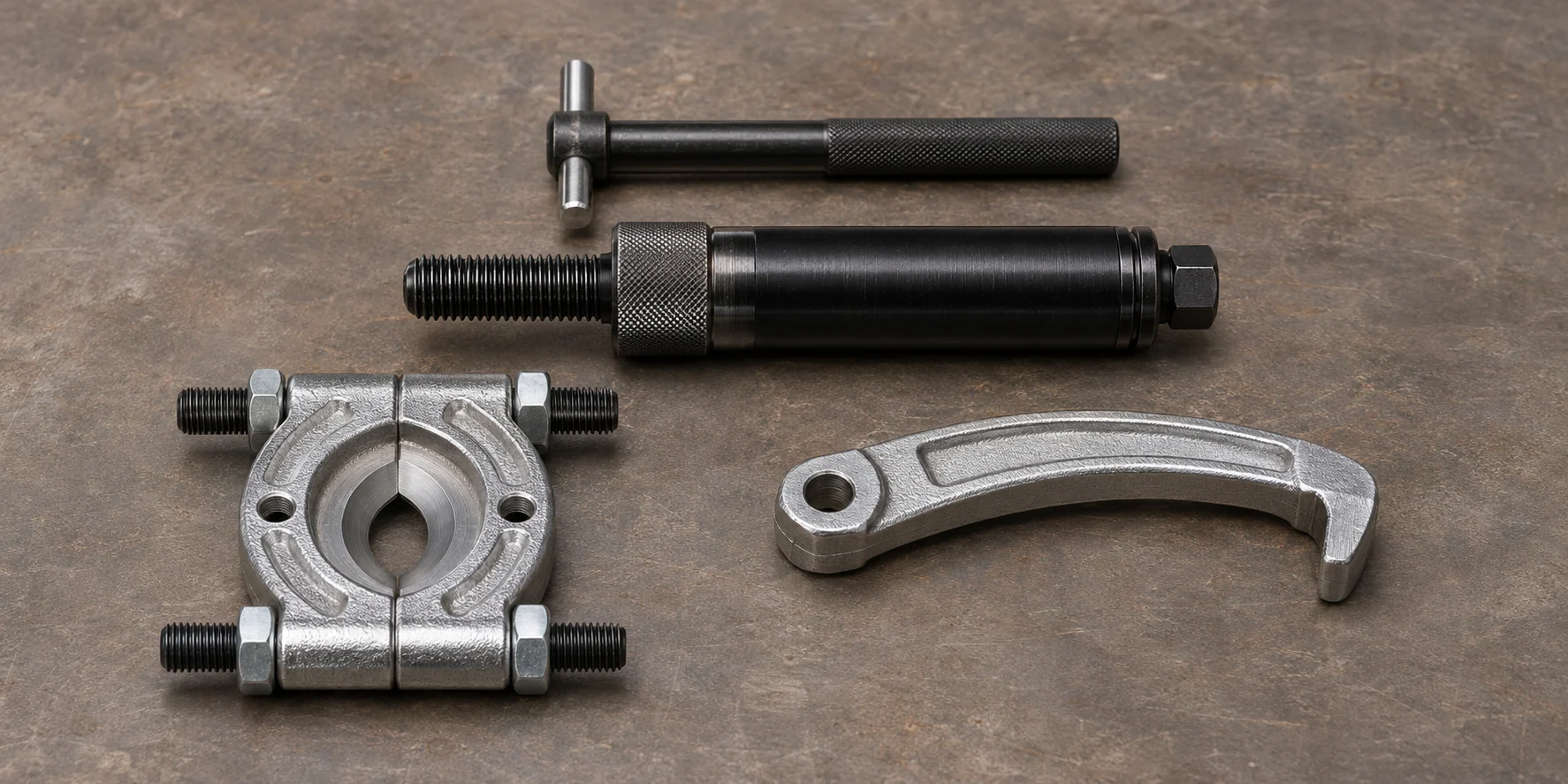
Capacity describes a rated limit for a specified tool arrangement. Reach describes how far the pulling components can extend to the engagement area; spread describes the opening between the jaws. Request the manufacturer’s dimension drawing because maximum reach and maximum spread may not be available together. A catalogue headline can conceal a working position that is too short for the customer’s assembly.
Configuration changes can also change the limit. For example, the Enerpac SGM20 specification restricts its two-jaw configuration to 50% of its rated puller capacity. That is a rule for that product, not a conversion factor for VIKTEC tools. It demonstrates why buyers should ask for limits by configuration instead of transferring the largest number on the carton to every setup.
Clarify the unit behind a tonnage label. A supplier’s stated capacity, the hydraulic pressure and the assembly’s required removal force are different quantities. Do not infer one from another without the applicable engineering information. Likewise, a product name containing “10 ton” does not prove that it will remove every seized bearing below a certain diameter.
For a useful comparison, send both suppliers the same application drawing. Mark the component diameter, access behind the component, required pulling reach and available space around the reaction point. Ask each supplier to identify a proposed configuration against that drawing. An unexplained capacity number should not be treated as an application approval.
Use workshop demand to decide whether hydraulics adds value
There is no reliable universal rule such as “buy hydraulic above ten jobs a week.” Job frequency alone leaves out setup time, component access, maintenance and the cost of a tool being unavailable. A workshop handling several identical assemblies can evaluate a proposed system more accurately than a distributor serving an unknown mixture of repairs.
Occasional work across many smaller assemblies
A mechanical range can be a sensible starting point when the documented configurations cover the jobs. Prioritize usable dimensions, understandable instructions and replacement screws or jaws. The aim is a kit the customer can identify and maintain, rather than the largest possible number of pieces. Retain a separate route for jobs outside the tool’s stated range.
Repeated work on an identified assembly
Arrange a sample evaluation around the actual application and the approved service procedure. Record preparation, setup, operation, reset and storage separately. If a hydraulic system reduces one stage but adds another, the complete cycle will show it. This is a purchasing evaluation method, not a claim that either drive type is automatically faster.
Customers reporting difficult or corroded removals
Ask why the current tool was unsuccessful before recommending greater capacity. The workshop may have encountered an overlooked retaining feature, insufficient engagement, an unsuitable contact tip or an assembly requiring another removal method. A higher rated system should only follow an application review; it should not become the default response to every stalled operation.
Compare ownership cost without inventing a payback figure
Ask for quotations on the same scope, then build the comparison using the buyer’s own figures. Include the purchase price, missing accessories, freight, replacement parts, maintenance arrangements and any training needed to introduce the tool. For hydraulic equipment, clarify whether repair is handled locally, by replacement assemblies or through another documented route.
A useful internal calculation is total cost over a chosen period divided by the number of suitable completed jobs. The denominator matters: jobs the kit cannot actually cover should not be counted. Use observed sample results or workshop records for operating time. Supplier statements about convenience can inform an evaluation, but they should not be converted into guaranteed labour savings.
For distribution, also record the commercial consequences of unclear scope. A customer who expected a pump or an extra separator may return a technically sound kit. Clear contents photographs, component references and a visible list of required external equipment can be as valuable as a small difference in the opening purchase price.
Build the enquiry around a complete working system
The following information gives a supplier a practical basis for reviewing a quotation request. Attach photographs with a ruler or a dimensioned drawing where possible; a close-up without scale often hides the clearance that controls selection.
- Application: component type, assembly identification, accessible gripping surface and intended service method.
- Working dimensions: required reach, spread, rear clearance and surrounding obstacles, with units clearly shown.
- Configuration: jaw or separator arrangement, extensions and proposed reaction point.
- Power system: mechanical, integrated hydraulic or separate pump and cylinder; identify any existing equipment.
- Documentation: current instructions, contents list, configuration limits and replacement-part references.
- Commercial scope: quantities, destination market, packaging requirements and the items to be priced separately.
For a concrete starting point, compare the listed hydraulic gear puller and bearing separator set with the mechanical bearing separator puller set. Their product names identify possible enquiry routes; the final selection still depends on the current contents and application specifications.
What to verify before adding a model to your catalogue
Keep a small comparison record for each shortlisted configuration: base tool, gripping accessories, power components, working dimensions and separately priced items. If the mechanical offer includes two separators while the hydraulic offer includes only one, record that difference before comparing totals. Otherwise, the apparent price difference combines drive technology with a change in usable equipment.
Ask the supplier to separate product warranty terms from replacement-part availability. A component being replaceable does not mean it is covered as a warranty item, and a warranty statement does not explain how a workshop obtains a worn operating part. These are different questions that affect the support plan for an imported range.
Use the approved sample as a reference for the order, including component identity and the version of the instructions supplied with it. Check that the case inventory agrees with the quotation, that parts can be identified individually, and that the operating document describes the actual drive system. A photograph of a similar kit is not a substitute for that reconciliation.
Define acceptance requirements before ordering. These may include dimension checks, visible condition, identification of rated configurations and a supplier-agreed functional evaluation. Do not devise an improvised overload test. If a particular test report or market document is needed, name it in the enquiry and review its scope against the specific model.
A balanced distributor assortment can group tools by application first and provide mechanical or hydraulic options within those groups. This makes it easier to explain why a customer needs a different engagement arrangement instead of simply offering a more expensive version of the same tool.
Questions buyers ask before ordering
Should spare seals be included with every hydraulic puller order?
Not automatically. First establish whether the hydraulic assembly is intended to be serviced by the customer and which parts the manufacturer supplies. A sealed replacement unit may have a different support route from a field-serviceable cylinder. Request the applicable parts list and service instructions, then choose an initial spare holding based on the intended customer base.
Does a hexagonal spindle end mean impact-wrench operation is allowed?
No. The shape of the drive does not establish permission to use an impact tool. Use the drive method stated for the particular model and configuration. If the documentation does not address impact operation, do not advertise it as an approved feature.
Can a hydraulic spindle be fitted to an existing mechanical kit?
Only where the tool manufacturer approves that combination. Matching a thread or fitting the spindle through a bridge does not establish the rating of the assembled system. Identify the frame, jaws, extensions and spindle by part number when requesting compatibility information.
What should a distributor send for an initial range review?
Send representative customer applications, the proposed mechanical and hydraulic models, expected order quantities and destination market. Add any requirements for instructions, replacement parts or packaging as questions for the quotation. Send VIKTEC your puller application and quotation requirements to start that review with a defined purchasing scope.